 Dali Marketers
The quick answer
The displayed 1–10 Quality Score is not a direct auction input or a business KPI. Use its components to investigate relevance and customer experience.
What Google Ads Quality Score tells you
Quality Score is a keyword-level diagnostic for Search campaigns. It gives an indication of ad and landing page quality relative to other advertisers. The displayed score runs from 1 to 10.
It is not a profit score, and the number is not inserted directly into the ad auction. This distinction matters because a business can spend time chasing a higher score while neglecting whether enquiries are suitable or sales are profitable.
Use it as a prompt for investigation. If a relevant keyword is struggling, its components may point you toward the ad, the page or the relationship between them.
Understand the three components
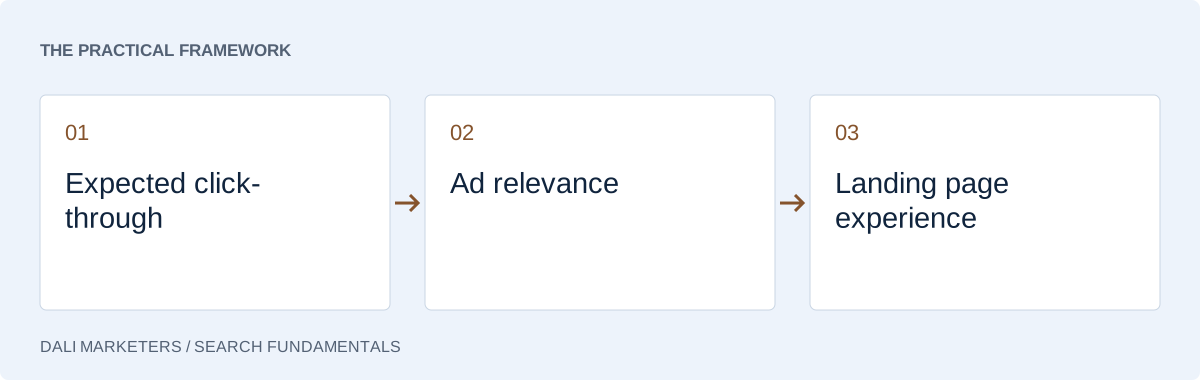
Google reports expected click-through rate, ad relevance and landing page experience. Their ratings indicate possible areas to review rather than prescribing one universal fix.
| Component | Question for your review |
|---|---|
| Expected click-through rate | Does the ad give a suitable searcher a useful reason to choose it? |
| Ad relevance | Does the message address the intent behind the search? |
| Landing page experience | Does the destination help the visitor complete the intended task? |
A missing score can mean there is insufficient matching search history. It is not the same as a score of zero.
Investigate relevance before rewriting everything
Read the keyword, likely intent, ad and destination as one journey. If the keyword concerns commercial signage but the ad and page focus on general printing, the mismatch deserves attention.
Group related needs sensibly. A small business does not need hundreds of tiny ad groups merely to appear organised. It needs ads and pages that give each meaningful customer need a relevant answer.
Do not insert the keyword into every line. Clear service details, a useful offer and accurate expectations are more valuable than repetitive copy.
Improve the page for the person arriving
Check the first screen on mobile. Can the visitor understand the service, see whether it fits and find a working contact route? Review load behaviour, readability and distracting elements.
For an audit service, explain the deliverable and the difference between consultation, diagnosis and implementation. For a local service, explain where you operate and the work you accept. The right details depend on the buyer’s decision.
Use the landing page checklist to test the full journey. Improving the page is worthwhile even before any diagnostic score updates.
Do not use the score as a CPC calculator
A common oversimplification says that moving from one Quality Score to another guarantees a particular reduction in click cost. Avoid using that claim to forecast savings. The live auction considers more context than the historical diagnostic number.
Better ad quality can support stronger auction outcomes, but competition, bid, context and other factors also matter. Read our Google Ads auction guide for a practical explanation.
If your score improves while qualified enquiries decline, the business has not necessarily improved. Follow the downstream outcomes.
Choose a useful test and document it
Suppose your page promotes several services but the campaign advertises one. A useful hypothesis is that a clearer destination will help the right visitors understand the offer and enquire. Record the change and compare suitable enquiries over an appropriate period.
Keep other major changes limited while evaluating the test. If budgets, targeting, ads and the page all change together, it becomes harder to understand the result. Consider seasonality, conversion delay and the amount of data available.
Prioritise issues affecting meaningful spend or business-critical services. A low-volume keyword with little commercial importance should not consume the entire review.
Keep the score in its proper place
A balanced review combines diagnostic clues with accurate conversion measurement, search intent and lead quality. It does not grade an account by an average of Quality Scores.
If you are unsure which issue deserves attention, start with the Google Ads audit checklist. Our audit service reviews the wider account and prioritises recommendations based on the evidence available.
The goal is a more useful customer journey and better-informed decisions. Treat the score as one clue along the way.
Sources & further reading
Platform details checked against these Google resources on 23 September 2026. Examples and diagnostic frameworks are explanatory; account results will vary.