 Dali Marketers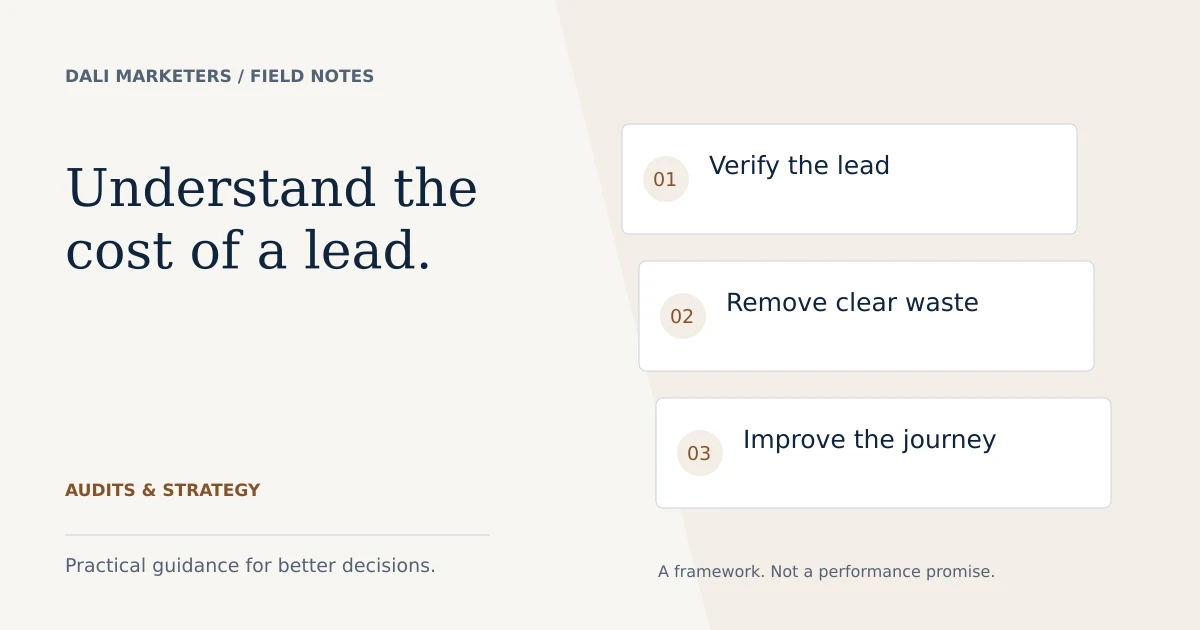
The quick answer
A lower cost per lead is useful only when lead quality is maintained. Compare qualified opportunities and customers, not just contact events.
Start by checking what the denominator means
Cost per lead is advertising spend divided by the number of leads. The arithmetic is simple; the definition is often the problem. If one report counts WhatsApp clicks and another counts completed enquiries, their costs are not comparable.
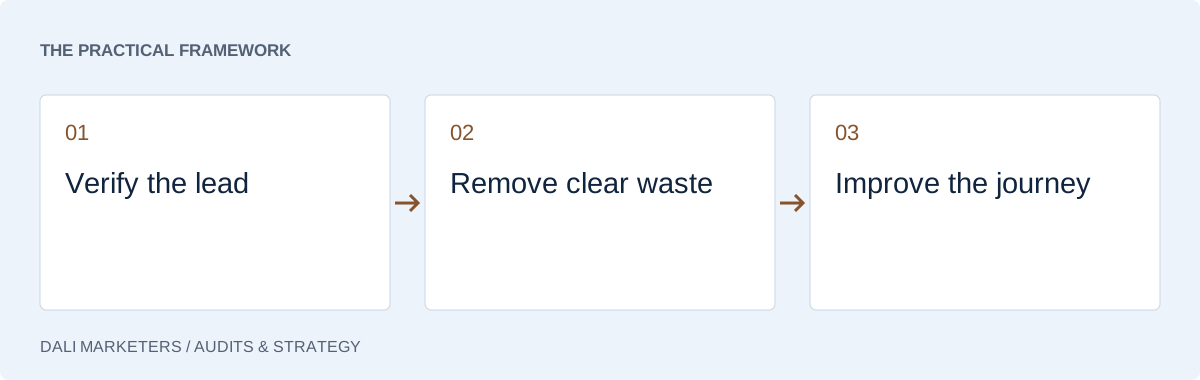
Before trying to reduce Google Ads cost per lead, define the outcome and verify the tracking. Then separate raw enquiries from qualified opportunities. A campaign that attracts a large number of unsuitable requests can look efficient while creating extra work for your team.
Decide whether your report shows media cost alone or includes management and other acquisition costs. Both can be useful, but they should be labelled clearly.
Work backwards from the business
Use your own sales process to estimate what an enquiry is worth. Consider how many qualified enquiries become customers and the contribution those customers generate after the direct cost of serving them. Avoid choosing a target purely because someone online reports a cheaper lead.
For an illustrative example, if one in five qualified leads becomes a customer and you can allow $200 in advertising cost per customer, the corresponding advertising allowance is $40 per qualified lead. That is a planning assumption, not a promise or an industry benchmark.
Revisit the assumptions when margins, close rates or the service mix changes.
Separate click cost from conversion rate
A simplified relationship is: cost per lead equals average cost per click divided by the click-to-lead conversion rate. At a $2 average click cost and a 5% conversion rate, the illustrative cost per lead is $40. If conversion rate rises to 8% at the same click cost, it becomes $25.
This does not mean you can choose a conversion rate at will. It shows why the landing page and enquiry process deserve attention alongside bids. Cheaper clicks from the wrong audience may reduce click cost while worsening lead cost.
Use the calculator below to explore assumptions. It is a planning tool, not a campaign forecast.
Explore your lead-cost assumptions
Excludes management fees and other costs. With JavaScript disabled, the example above still explains the calculation.
Remove clear mismatches before cutting useful demand
Review search terms, service areas and settings for spend that cannot plausibly support your offer. A service-only business may not want product-shopping searches; a local provider may not serve the places generating enquiries.
Use exclusions carefully. Do not pause a relevant search simply because it has not produced a lead after a few clicks. Consider the sales cycle and evidence available. Keep notes so you can distinguish a deliberate test from an accidental loss of demand.
Our negative keyword guide explains how to limit the reach of an exclusion.
Improve the page and the response process
Make the advertised service easy to understand and contact options easy to use. Address price, scope and suitability before the visitor needs to ask basic questions. Fix broken forms, inaccurate phone links and unreadable mobile layouts first.
Then inspect what happens after the enquiry. If suitable prospects are lost because nobody follows up, buying more leads does not repair the problem. Compare the performance of campaigns using a consistent response process.
Use the landing page checklist to identify a focused change you can evaluate.
Review bid targets and results deliberately
Do not assume that making a target more aggressive will force the account to produce the same volume more cheaply. Targets must be considered alongside the available conversion data, competition and business constraints.
Document the change and give the evaluation a sensible window. Allow for conversion delay and compare similar periods where possible. Avoid changing budgets, goals, ads and pages together unless you are fixing a clear emergency; otherwise you lose the ability to understand what helped.
For ongoing review, Google Ads management provides a recurring process. If the measurement is uncertain, begin with an account audit before committing to a lower cost target.
Sources & further reading
Platform details checked against these Google resources on 23 September 2026. Examples and diagnostic frameworks are explanatory; account results will vary.